

Tracking parameter sweep
Question
Across the tested homeostatic parameters, where does a randomly initialized Falandays tracking reservoir remain above a predeclared tracking threshold, and which recorded internal summaries accompany failure?
Design
The study contains two grids:
- a one-at-a-time sweep over
leak,lrate_targ,lrate_wmat,input_amp,movement_amp, andeye_offsetaround the reference configuration; - a factorial
leak × lrate_wmatgrid.
Each cell uses the same 100 seed identities, enabling paired cell contrasts. A run lasts
7200 ticks with a 100-tick warm-up. The primary behavioral quantity is
frac_within_30deg, the post-warm-up fraction of ticks with gaze within 30° of the target.
The protocol labels a run viable when this fraction exceeds 0.25; the geometric chance
reference for a uniformly unrelated gaze is .
julia --project=. experiments/run.jl tracking_param_sweepjulia --project=. experiments/run.jl tracking_leak_lrate_factorialThe complete design is 3200 cell-runs in the one-at-a-time study and 3000 cell-runs in the factorial study. These are not 3200 or 3000 independent seed identities: each grid reuses 100 identities across cells.
Descriptive results
The per-seed distributions are mixtures: many runs remain near chance while a varying fraction cross the viability threshold. The figures therefore show seed-level values and viable fractions rather than only mean ± standard deviation.
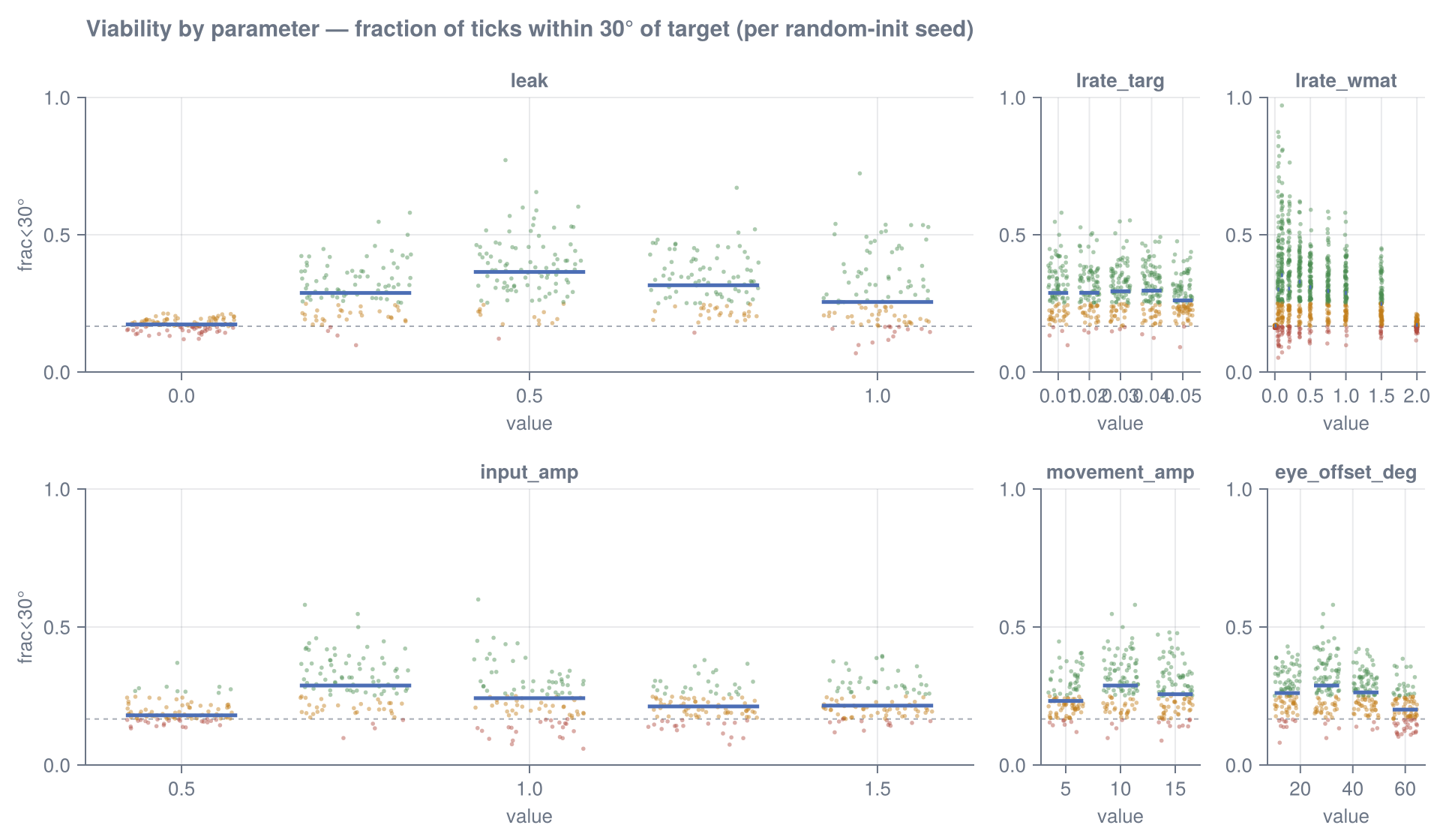
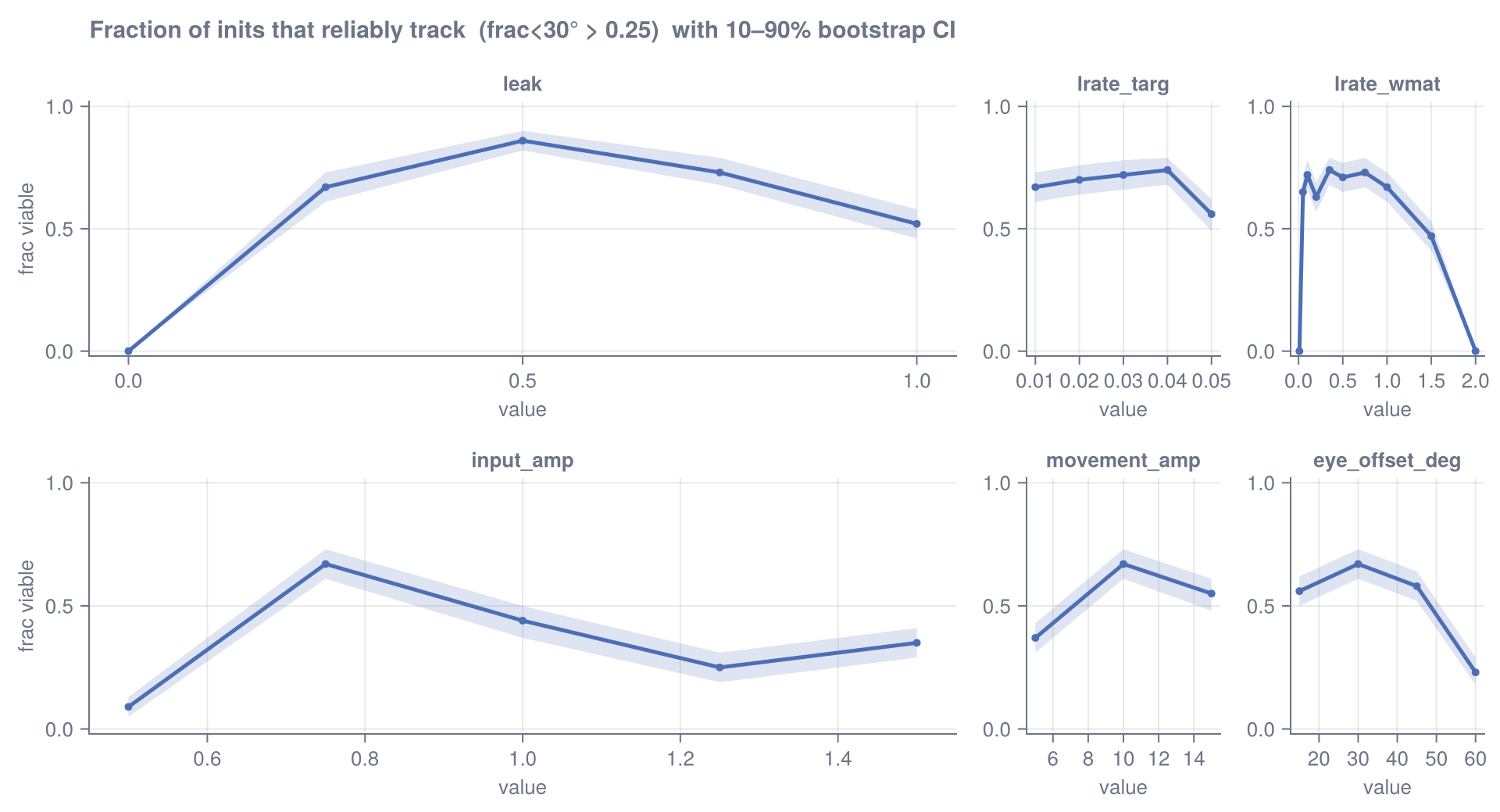
Within the tested one-at-a-time values, input_amp=0.75, movement_amp=10, and
eye_offset=30° have the largest observed viable fractions on their respective axes.
leak=0 collapses in this protocol, while intermediate leak values retain many viable
runs. lrate_wmat also fails at the tested extremes.
The factorial shows a structured interaction: viable fractions depend on the combination of leak and weight-learning rate rather than either marginal alone.
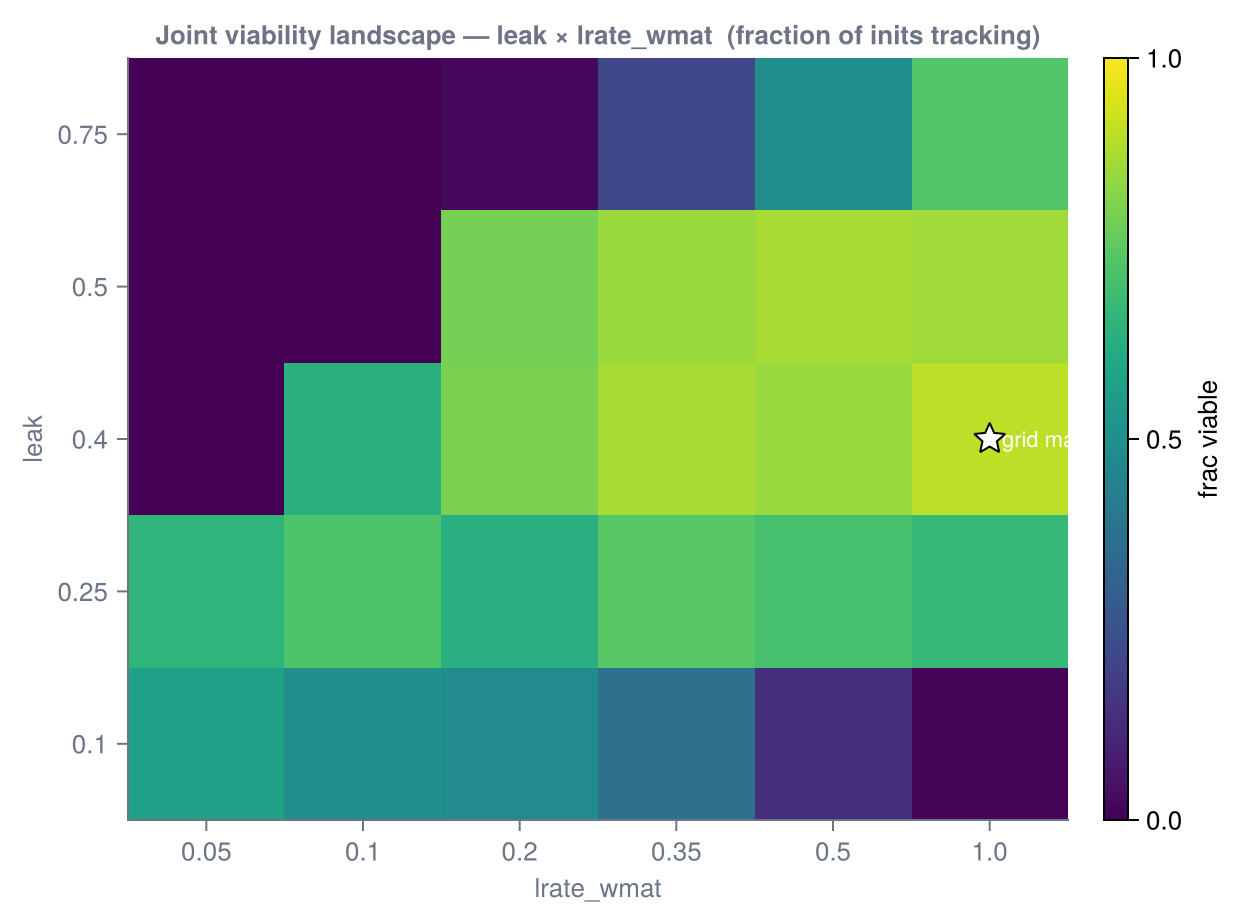
The largest observed value on this grid is 0.90 at leak=0.4 and
lrate_wmat=1.0. This is a discovery estimate selected from the same grid. It should not
be called an optimum without a held-out confirmation design or simultaneous inference.
Internal summaries
The homeostatic set-point error, node_target_error = |acts - targets|, is associated with
failure in the pooled descriptive data. Runs labeled viable have mean tail summaries of
approximately 0.312, versus 0.387 for non-viable runs; the pooled correlation with tracking
score is approximately −0.164.
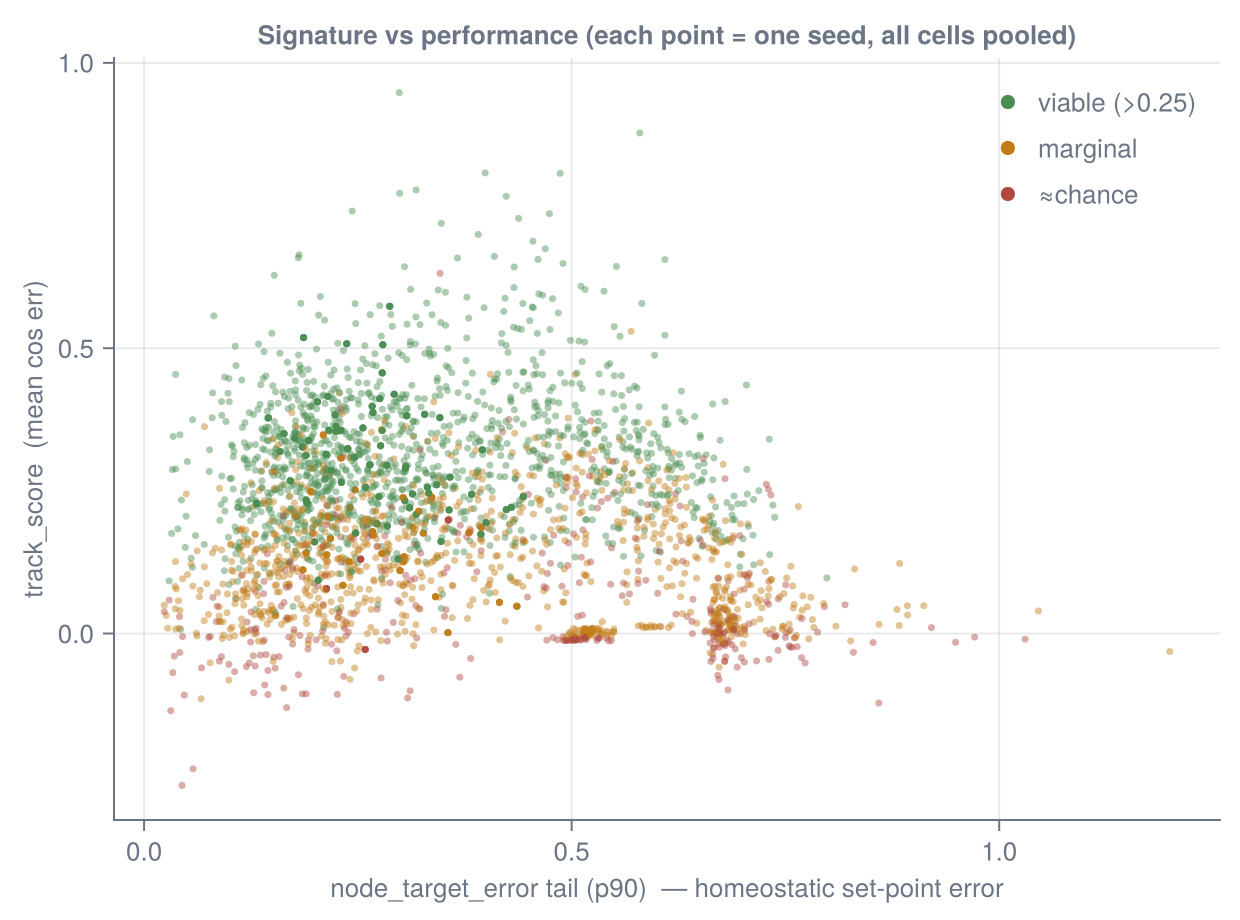
This supports a limited interpretation: large target error is a useful failure warning in this grid. Low error is not sufficient for tracking, and the pooled association combines parameter and seed effects. A seed-paired hierarchical analysis would be required for a stronger mechanistic claim.
Branching estimates near one are not a unique marker of tracking in this online homeostatic model, because activity is directly regulated. Spectral radius is a structural diagnostic but not, on its own, a nonlinear criticality test.
Uncertainty and selection
The plotted bootstrap bands use the 10th and 90th percentiles: they are 80% intervals. They should not be read as 95% confidence intervals. Because the same seeds appear across cells, resampling and contrasts should preserve seed identity. The current descriptive page does not apply simultaneous correction across every searched cell and does not use a held-out confirmation set.
Data and provenance
Committed packets:
experiments/results/tracking_param_sweep/20260708T214553Z_752b528/experiments/results/tracking_leak_lrate_factorial/20260708T214041Z_752b528/
Each contains per-seed results.json and manifest.txt. The figures are generated by
experiments/figures/tracking_figures.jl.
Download the copies published with this site: one-at-a-time results · factorial results · one-at-a-time manifest · factorial manifest.
The manifests record the commit, settings, timestamp, and seed list. They do not include a dirty patch, full Julia/package inventory, or Manifest copy/hash, so bit-for-bit reproduction also assumes the committed tree and environment identified by the repository.
Regenerate the four published figures from those exact committed packets:
julia --project=experiments/figures experiments/figures/tracking_figures.jl \ experiments/results/tracking_param_sweep/20260708T214553Z_752b528/results.json \ experiments/results/tracking_leak_lrate_factorial/20260708T214041Z_752b528/results.json \ site/public/experiments/tracking-sweepInterpretation
Within this tested grid, tracking viability is initialization-dependent and shows a clear leak-by-learning-rate pattern. The data establish a descriptive viable region and a useful failure diagnostic. They do not establish a globally optimal parameter setting or a causal role for target error.