
Nodes and reservoirs
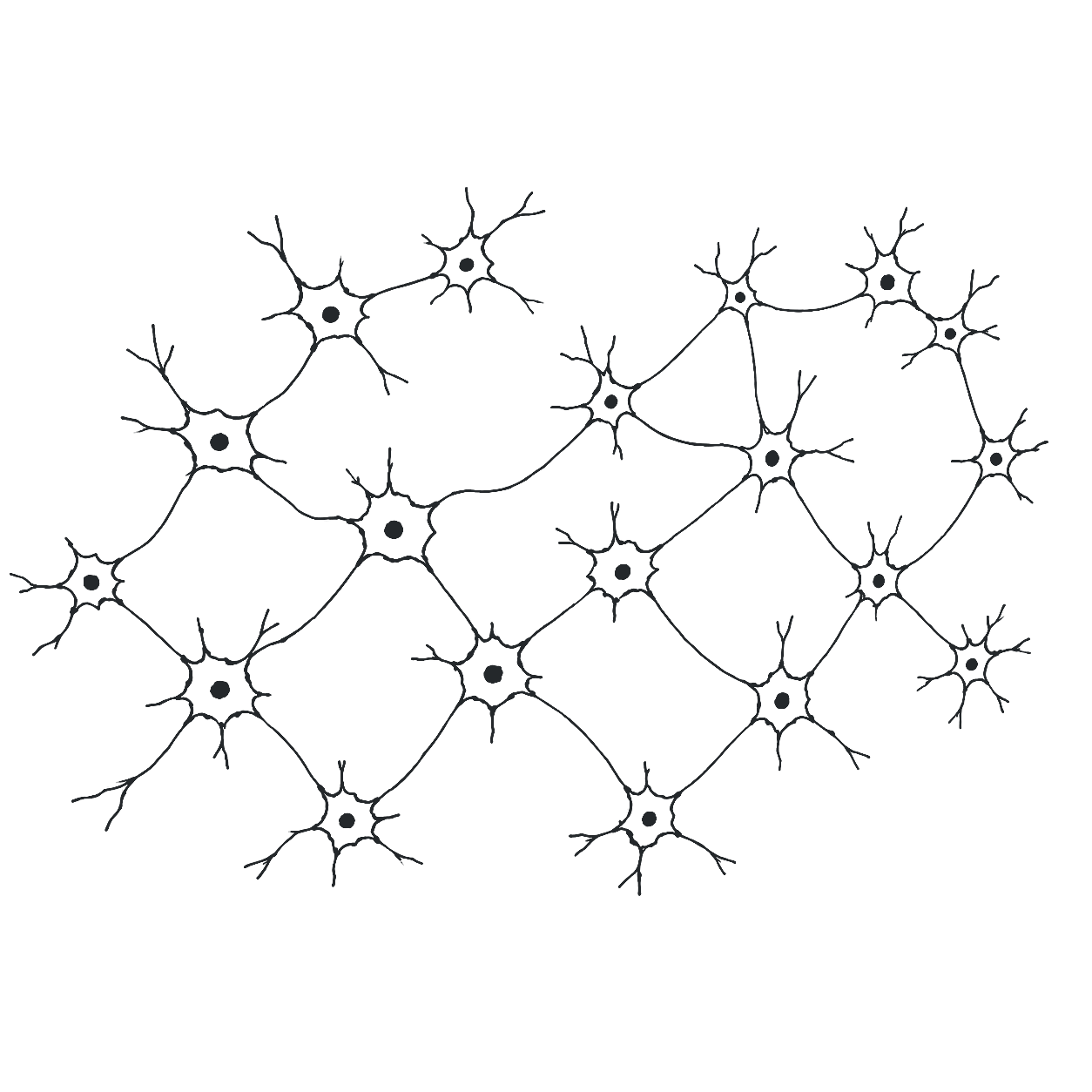
A node specifies a local neural rule. A reservoir is a population of those nodes with
wiring and dynamic state. NodeSpec selects the model family and its parameters;
CompositionSpec.count sets population size.
Resolve a model in a task
from brainlesslab import CompositionSpec, NodeSpec, TaskSpec, profile, resolve
plan = profile(    CompositionSpec(NodeSpec("sorn"), TaskSpec("delayed_cue"), count=32))target = resolve(plan).targets[0]print(target.model_config)print(target.n_inputs, target.n_effectors)
Resolution shows the completed configuration and task ports without allocating a device. It does not certify that the selected wiring will perform well.
The active families are Falandays and
SORN. Both construct owned arrays on the host and advance
state in Quadrants. Runtime matrices use [destination, source] orientation; batches add
a leading slot dimension. Readouts average selected binary activity into effector values.
Dense arrays are the current baseline. A sparse construction mask can remove connections, but it does not make storage or stepping a sparse algorithm. Runtime node and batch dimensions have fixed ndarray ranks.
Distinguish state from adaptation
Falandays combines leaky activation, threshold firing, recurrent weight adaptation and target adaptation. Its unsigned and Dale-axis configurations have distinct rules. SORN combines synchronous excitatory/inhibitory binary state, E-to-E STDP, row normalisation and intrinsic excitatory-threshold adaptation.
Online adaptation is part of these equations. It does not require a teacher or task loss. An improved task score alone does not show which adaptation caused the change; compare appropriate frozen and input controls.
freeze_weights leaves Falandays target adaptation or SORN intrinsic plasticity active.
freeze_plasticity disables all declared adaptation. Neither stops recurrent dynamics.
A full reset restores initial weights, masks, dynamic state and plasticity flags.
Check the software boundary
uv run pytest python/tests/test_falandays.py python/tests/test_sorn.pyThese suites cover their declared equations, ordering, threshold cases, reset, frozen modes, ownership and batch independence. Falandays also has specific archival fixture checks. Validation of the earlier implementation covers its declared reference trajectories; Python equation conformance and backend qualification remain separate. See version history for that boundary.
SORN’s inhibitory_fraction is the historical name for an I/E ratio. Its E-to-E
construction uses a connection probability, and pruned edges do not regrow. Software
checks do not establish parity with every author’s implementation, criticality or
biological fidelity.
Use separate processes for different arithmetic/backend policies. Warm compiled kernels before timing them. Continue with runtime performance, interfaces and learning exercises.